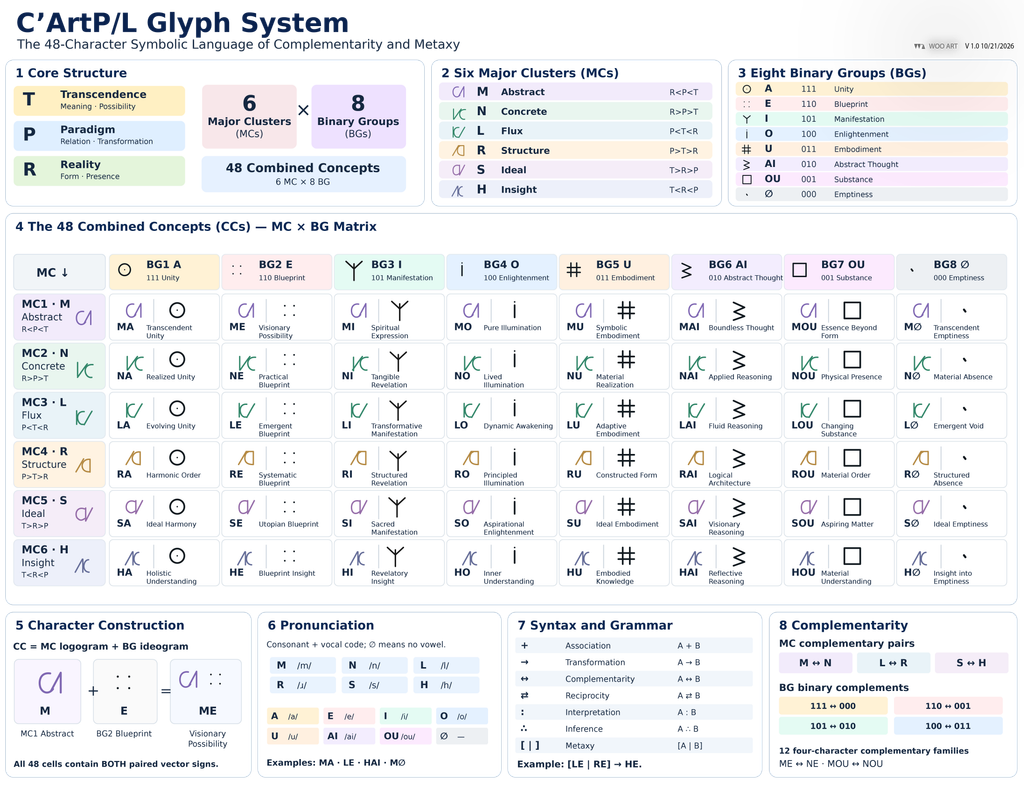
C’ArtP/L, or the C’ArtP Language System, is a writing system John HR Woo created as part of his Caligomos Art Philosophy. It uses paired symbols, clear verbs, and a simple grammar to help people give shape to new ideas.
Writers use C’ArtP/L to explore ideas, show connections, and find new meanings through creative work.
C’ArtP/L is built around three key ideas: Caliginosity, Kosmos, and Metaxy.
Caliginosity is about things that are unclear or not fully understood. Kosmos is about order and how things fit together. Metaxy is about the space in between, where different needs or ideas can exist even if they aren’t balanced.
Writing with this system helps you explore how these ideas connect.
C’ArtP/L organizes ideas into three main groups:
– Transcendence (meaning and possibility)
– Paradigm (relationships and change)
– Reality (form and presence)
There are also six Major Clusters that help focus on these groups:
– M is Abstract
– N is Concrete
– L is Change
– R is Structure
– S is Ideal
– H is Insight
There are eight Binary Groups, each representing a key concept:
– A is Unity
– E is Blueprint
– I is Manifestation
– O is Enlightenment
– U is Embodiment
– AI is Abstract Thought
– OU is Substance
– ∅ is Emptiness
Each group has its own symbol, pattern, and sound. Combining a Major Cluster with a Binary Group creates one of 48 Combined Concepts.
Each Combined Concept has a symbol, name, pronunciation, and verb.
For example:
– ME stands for Visionary Possibility and uses the verb Envision
– NE stands for Practical Blueprint and uses the verb Plan
– NU stands for Material Realization and uses the verb Construct
These forms help you see, understand, and use the ideas. The pronunciation usually combines the Major Cluster letter with the Binary Group vowel. If the code is ∅, there is no vowel sound.
Grammar connects symbols into expressions.
– Association joins actions
– Transformation shows change
– Reciprocity gives feedback
– Interpretation explains meaning
– Inference draws a conclusion
– Metaxy highlights the space between ideas
Complementary actions change the Major Cluster, the Binary Group, or both to their matching partners. This creates twelve families, each with four related characters.
For example, ME, NE, MOU, and NOU connect the ideas of Envision, Plan, Essentialize, and Examine. These are related, but their verbs are not just opposites.
Writers can start with an image, a question, some material, or an idea. They pick a focus, choose the right characters, set up relationships, read what they have created, and improve it through experience or feedback. Adding nouns clarifies actions, and context shows who is involved, what is happening, and why. Grouping rules help explain complex expressions.
People use C’ArtP/L for poetry, stories, music, visual art, sculpture, ceramics, performances, installations, teaching, and C’Elysium workshops. One idea can take many forms in different types of art. When using colours, sounds, movements, or materials, clear rules are needed.
C’ArtP/L is useful because it helps people talk about their choices. For example, you can discuss:
– Why a character is used- How an action changes a relationship
– What context adds
– Whether someone else can understand your main idea clearly
C’ArtP/L is still growing as a language. Its 48 characters are shared reference points, not a complete system for every experience.
Good documentation separates official rules from new ideas and suggestions. The system works best when people use it carefully, explain it clearly, review it critically, and stay open to new meanings that come from writing.
Date: 10/21/2026. Woo Art Studio